
A research project by Adolfo Giuliani developing a conceptual framework for legal-historical research through the philosophy of information.
Why information?
We live, think, and work immersed in information. That is not merely a technological condition: it is a philosophical one.
The information revolution has not added new tools to old problems. It has transformed the conditions under which we perceive reality, form identities, produce knowledge, and ask questions. When those conditions change, law cannot remain unaffected. Law operates through concepts. Concepts are its basic instruments: they classify facts, organise arguments, stabilise authority, and make judgment possible. But concepts belong to their time. When reality is reorganised, the conceptual apparatus of law must be reconsidered.
InfoLaw’s wager is that the philosophy of information is the right framework for understanding contemporary law — and for rethinking it.
The philosophical foundation
InfoLaw draws on the philosophy of information: a field that has acquired rigour and depth over recent decades, while remaining rooted in the great movements of twentieth-century philosophy — post-Kantian thought, pragmatism, the philosophy of language, logic, and ethics. It is not a break from tradition. It is the next step.
The key insight, developed most rigorously by Luciano Floridi, is that information is now as philosophically fundamental as being or knowledge. We are informational organisms; the environment we inhabit is constituted by information. Mireille Hildebrandt and others have begun to show what this means for law. InfoLaw takes that work further — into legal history, legal epistemology, and the long transformation of legal concepts.
Legal thought has never worked in philosophical isolation. Aristotelianism, Scholasticism, Rationalism, Kant, pragmatism — each gave law a conceptual framework suited to its time. The philosophy of information is the framework for ours.
Origin
InfoLaw began in September 2019, when its research agenda was first presented at an international conference in Helsinki.
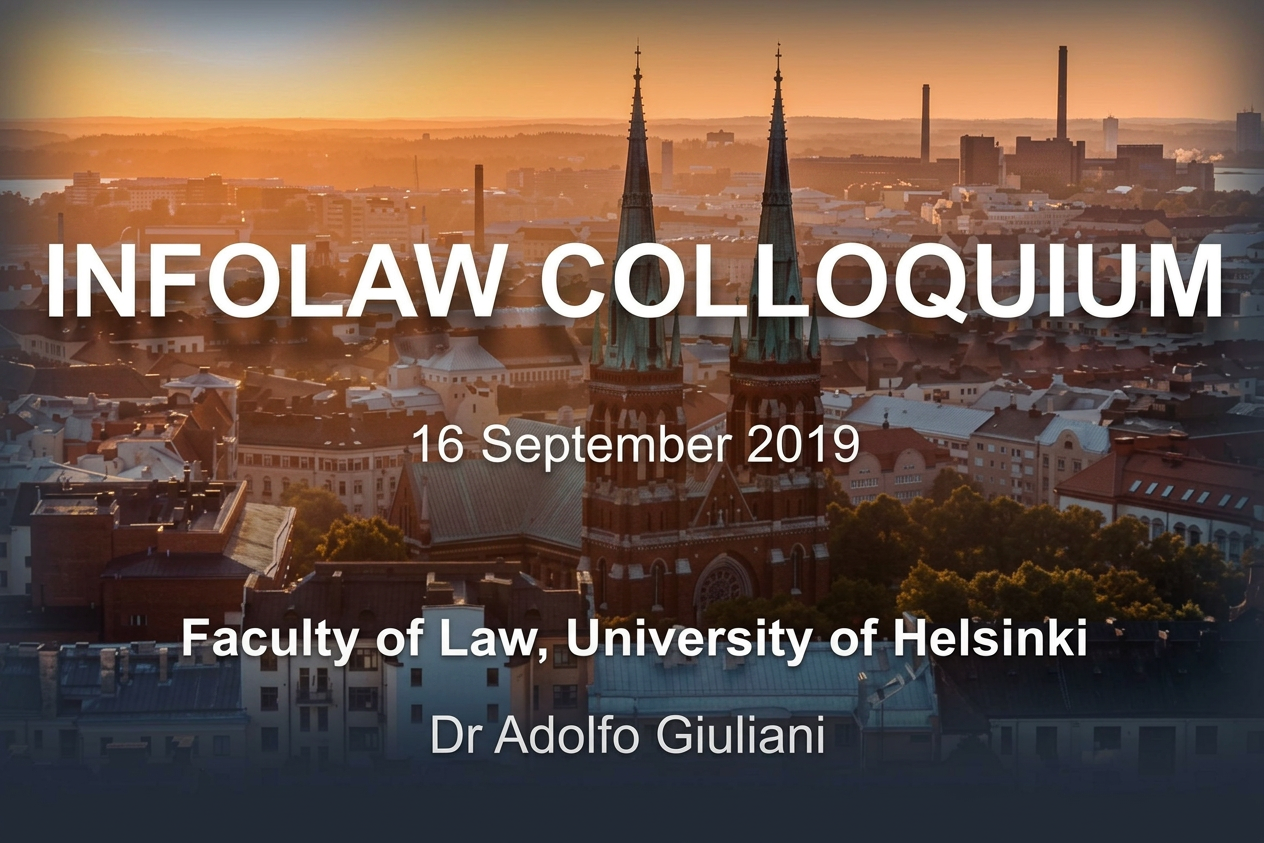
The opening question was simple:
How is the information age changing traditional ways of thinking about law?
Everything since has been an attempt to answer it. The work has ranged widely — legal history, legal theory, temporality, conceptual design, rhetoric, judicial evidence, historical evidence, digital legal knowledge. One thread runs through all of it: thinking about law informationally.
Themes
Judicial evidence
How do judges know what happened? How do testimony, documents, objects, and probabilities become legally usable knowledge?
InfoLaw treats judicial evidence as an informational problem. The central focus is the distinction between testimonial and non-testimonial knowledge. That distinction is traced historically through legal presumption — the mechanism by which courts have long converted uncertain, incomplete information into judgment.
Historical evidence
Judicial evidence opens onto a broader question: the relationship between the judge and the historian.
Both reconstruct the past from traces. Both work under constraints of evidence, relevance, interpretation, and narrative coherence. But their tasks diverge. The historian produces an account of the past; the judge produces an authoritative decision in the present. One is answerable to the past; the other acts in the present.
That difference matters. InfoLaw reopens the judge-and-historian debate — central to jurisprudence and historiography in the mid-twentieth-century, yet unfinished today — with the resources of information philosophy.
Conceptual design
Law cannot function without concepts. They are not abstractions — they are instruments. They select what is relevant, organise facts, structure reasoning, and make judgment possible.
Legal theory and legal history have often retreated from conceptual analysis, suspicious of doctrine and systematic thought. The cost has been real: methodological weakness and lost ambition.
InfoLaw reclaims conceptual rigour — not to revive formalism, but to understand concepts as instruments of legal knowledge: designed, operative, revisable.
Representation
Law does not mirror reality. It represents it — at a particular level of abstraction, for a particular purpose.
Rules, doctrines, presumptions, models, categories, narratives: all are representational devices. They reduce complexity, organise information, and make reality available for legal reasoning. But every representation also selects, excludes, and transforms what it represents.
InfoLaw studies legal representation as a central feature of legal knowledge. To think about law informationally is to ask how legal representations are constructed, how they travel through time, and how they shape the very reality they claim to describe.
Temporality
Law operates in time and on time. It preserves the past, acts in the present, and projects norms into the future.
Legal traditions, precedents, codes, and doctrines are forms of temporal transmission — they carry normative information across generations. The past does not disappear; it remains available, contested, reinterpreted, reactivated.
InfoLaw studies this through the idea of the long now of law: the extended present in which inherited legal information continues to operate. Legal history, on this view, is not the study of what has passed. It is the study of how the past remains present.
Purpose
Law is normative information moving through time — encoded in texts, institutions, procedures, arguments, classifications, memories, and digital systems.
To think about law informationally is to ask how it knows, remembers, communicates, classifies, represents, and changes.
About
Adolfo Giuliani is a legal historian and coordinator of the InfoLaw Research Project. His work focuses on legal history, legal theory, legal tradition, judicial evidence, temporality, and the conceptual foundations of legal knowledge.
Adolfo Giuliani
Infolaw Research Project
giuliani@infolaw.net